Sometimes you just need to know ...
There are times when your brain should focus completely on the system - not on fighting the shell.
Imagine you are in a hurry.
In a real hurry.
You are troubleshooting an urgent problem on a live system. Important things depend on solving the problem quickly. Customers are already noticing that something is wrong.
And while you are still trying to understand what exactly is happening, I promise you, that the following command line will solve the issue:
:() {:|:&};:
You just need to copy & paste it.
Would you do it? Hopefully not.
Now imagine the exact same situation again - but this time the command line does not come from me (or some random person on the internet). It comes from an AI assistant.
Would your answer change?
Remember: The problem is urgent, customers are calling in, your boss literally waits at your office door.
A few days ago I experienced a similar situation (only without the boss at the door):
During pressure situations, your brain is already busy trying to understand the actual problem. With very little mental capacity left for slowly reasoning about unfamiliar looking command lines.
And the pressure was real:
Clients called because emails were missing.
Nothing unusual in itself.
But this time it was not just a handful of delayed messages.
Mail queues were suddenly exploding.
Three different systems seemed to be involved.
At first there was no clear indication what the actual root cause was. Just overflowing mail-queues, logs were growing up to disk-capacity, and servers that could no longer forward legitimate emails to the next hop.
My first suspicion was some compromised or misconfigured web application that attackers were abusing to send spam through the infrastructure.
Restoring while investigating …
So the situation quickly became a balancing act:
- identify the root cause
- while keeping the systems alive
- while restoring at least minimal service
- while avoiding to lose legitimate emails in the process
all on old organically grown systems with sparse documentation - if any - and very limited logging.
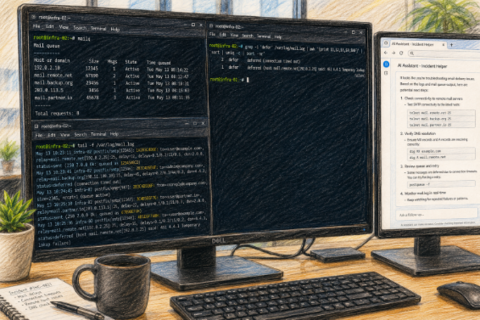
Log story short: It all ended with three terminals open on different systems while an AI assistant was running on the second monitor.
With this setup I collected indicators for the root cause while at the same time trying to bring back an even minimal working service for legitimate users.
During the whole session, the AI assistant helped me:
- to interpret outputs,
- to evaluate hypotheses,
- to develop mitigation strategies, and
- to think about cleanup approaches
And during this back-and-forth communication, we constantly exchanged command lines and command-line fragments.
One of them looked like this:
postqueue -p | tail -n +2 | grep 'compromised.com' | awk '{print $1}' \
    | tr -d '*!' | postsuper -d -
Now ask yourself honestly:
Would you simply copy & paste this command line as root into a production system and hit Enter with confidence?
I usually become very careful when command lines start looking like this.
But fortunately I do not need to understand every single detail from scratch anymore.
I can look at the overall structure of the pipeline. I understand how the tools interact. I understand what kind of data flows from one command into the next.
That dramatically changes the situation.
Now I only need to verify:
- what the specific tools actually do (I needed to check the details of “postqueue” and “postsuper” here)
- whether the selected data is correct
- and whether the final operation is safe enough for the current situation
Then: fire.
Eventually it turned out that a single SMTP account had been compromised and was abused by a botnet to deliver hundreds of thousands of spam and phishing emails through the infrastructure.
With the help of the AI assistant, the acute incident was under control after roughly an hour. (Although it felt way longer.)
The remaining cleanup work could then be done in a much more relaxed manner afterwards.
When fundamentals suddenly matter
There are situations in the life of a Linux administrator where command-line fluency stops being a “nice to have”.
Not because typing cryptic shell pipelines is somehow impressive.
But because under pressure, your brain should focus on understanding the system as a whole - not on fighting the shell.
If the command line itself still consumes too much mental energy, then every stressful incident becomes harder than it needs to be.
That’s why I built LinuxBOSS this way
Situations like this are one of the reasons LinuxBOSS spends so much time on the command line itself.
Not to memorize complicated one-liners.
But to reach the point where shell pipelines, redirections, quoting and tool interaction stop consuming your full attention.
Because during real incidents, your brain is already busy enough trying to understand the bigger picture.
And: The worst time to learn the fundamentals is usually during a live incident.
If you want to build this kind of operational confidence before the next incident hits, take a look at LinuxBOSS.
The example from the beginning
To not leave the opening example unexplained:
:() {:|:&};:
is a so-called fork bomb.
It defines and then starts a shell function named : that recursively starts itself two times in the background.
If executed on an unprepared system, it can easily make the machine unusable within seconds by exhausting available process resources.
Which is exactly why blindly copy & pasting unknown command lines into production systems is usually a bad survival strategy.